



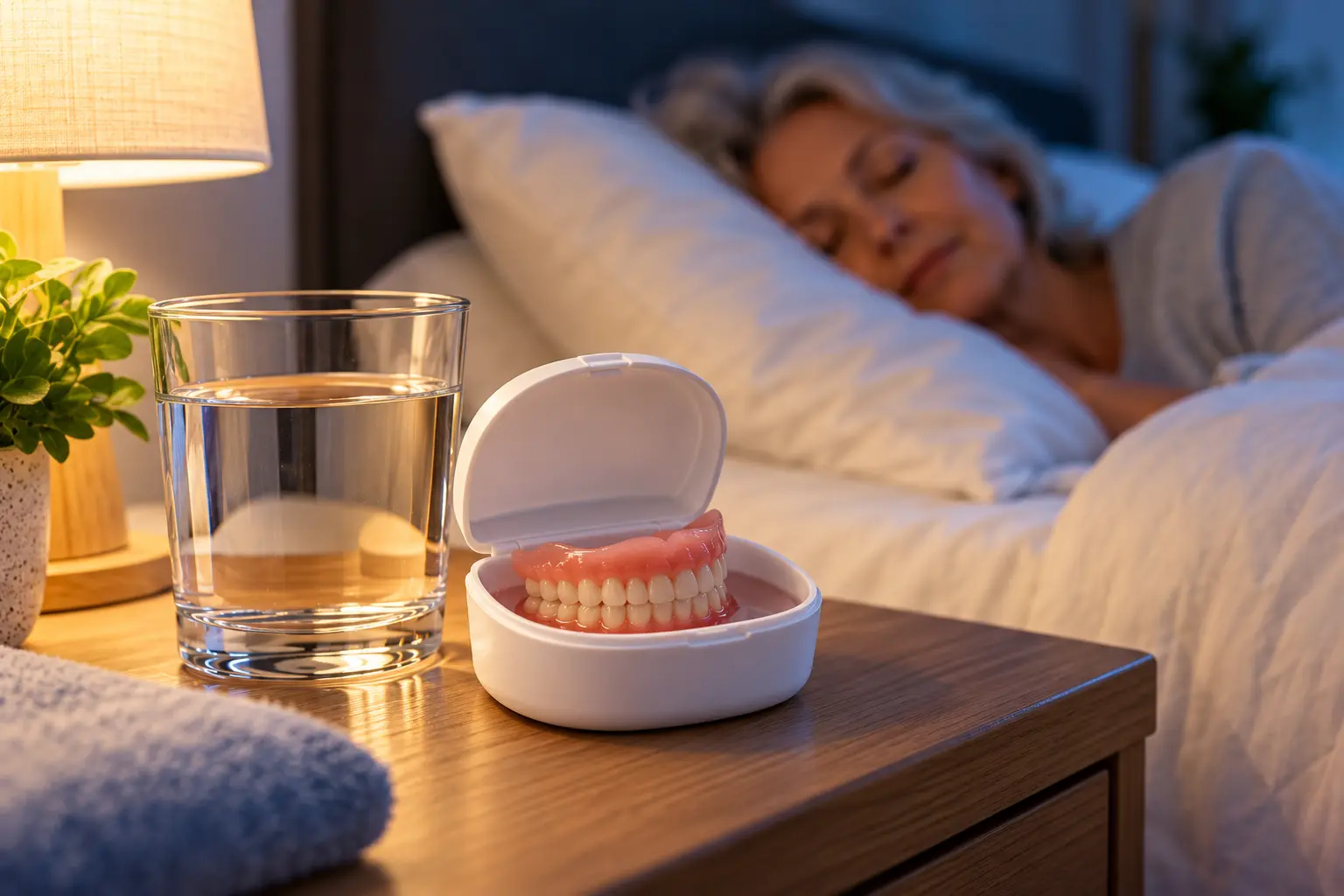
For most people who wear removable dentures, the answer is no. We recommend taking them out at night, because your gums need a rest and your dentures need a proper clean. Falling asleep in them now and then is not a disaster, but making it a habit is where problems start.
Below we explain why, what to do with your dentures overnight, the few cases where we might advise something different, and the signs that your dentures need attention.
Is it safe to sleep with dentures in?
It is not harmful as a one off, but it is not something we would want to become routine. A removable denture sits on your gums for the whole day. Leaving it in overnight means those tissues never get a break, and the denture never gets properly cleaned.
If you have been told by your dentist to keep your dentures in for a particular reason, follow that advice. Otherwise, out at night is the sensible default.
Why we recommend taking dentures out at night
Your gums get a rest. Dentures press on the tissue underneath them for hours. Taking them out overnight lets that tissue recover, and it can ease the soreness and redness some people notice under a denture.
Your mouth stays cleaner. Plaque and bacteria build up on a denture just as they do on natural teeth. Wearing it day and night gives them more time to settle, and a denture that is not cleaned well can lead to bad breath and gum irritation.
Saliva does its job. While you sleep, saliva helps wash and protect the mouth. A denture sitting over the gums for hours can get in the way of that, which is one reason fungal infections such as denture stomatitis are more common in people who keep dentures in overnight. It shows up as red, sore, sometimes white patches under the denture.
You protect the fit. Gums and bone change shape over time. Giving them a rest helps you notice when a denture has started to loosen, rather than living with it.
What if you fall asleep with your dentures in?
Do not worry. Take them out when you wake, rinse them, clean them properly, and give your gums a little extra time without them if you can. If your mouth feels sore or looks red afterwards and it does not settle, give us a call.
If you find yourself dozing off in them regularly, say so at your next appointment. It may be worth checking that they fit well.
Are there any exceptions?
Sometimes, yes. After teeth are removed, we may ask you to keep an immediate denture in for the first night or so, because it helps protect the area while it settles. That is a specific instruction for a short time, and we will tell you when to start taking it out.
It also matters what kind of denture you have. Removable dentures, including ones that clip onto implants, are taken out for cleaning and rest. A fixed set of teeth that is screwed onto implants is not a denture in this sense and is looked after differently. If you are not sure which you have, ask us.
What to do with your dentures overnight
Once they are out, give them a rinse and a clean, then store them somewhere safe.
- Rinse off any food and adhesive under running water.
- Brush the denture gently with a soft brush and a mild cleaner made for dentures. Ordinary toothpaste can be too abrasive.
- Soak it in water or a denture cleaning solution, following the instructions that came with your denture.
- Keep it in a lidded container somewhere pets and children cannot reach.
- Rinse it again in the morning before you put it back in.
Use cool or lukewarm water, never hot, because heat can warp the acrylic. If your denture has metal parts, check which cleaning solution is suitable, as some are not.
How to keep dentures clean day to day
Clean your dentures every day, after meals if you can. Brush your gums, tongue and any natural teeth too, because a clean mouth keeps the denture cleaner. Handle dentures over a sink of water or a folded towel so they do not break if you drop them.
For more everyday habits, see our tips on caring for your dentures.
What about denture adhesive?
Adhesive can make a well fitting denture feel more secure, but it should not be used to hold together a denture that no longer fits. Clean it off the denture and your gums every night. If you need more and more adhesive to keep your dentures in place, that is a sign it is time to have the fit checked.
Signs your dentures need attention
Book an appointment if you notice:
- sore, red or swollen gums under the denture
- white patches or a burning feeling in the mouth
- dentures that rock, slip or click when you talk or eat
- cracks, chips or a change in how your bite feels
- bad breath that does not go away with cleaning
Gums and bone change over time, so a denture that fitted well can loosen. A reline or adjustment often puts it right, and we can look at it quickly. Please do not use home repair kits.
When dentures keep coming loose!
If your dentures are never quite comfortable, or you avoid certain foods, it is worth looking at the options. A new set of dentures made to fit your mouth as it is now often makes a big difference. Some people prefer implant retained dentures, which clip onto implants and stay put, or would like to know whether dental implants could replace their dentures altogether. We can talk you through each, and what suits your mouth.
Frequently asked questions
Q. Can you sleep with partial dentures in?
The same advice applies. A partial denture also rests on your gums and clasps against your natural teeth, and plaque can build up around those teeth if it stays in overnight. Taking it out gives your mouth a break and makes cleaning easier.
Q. Should dentures be kept in water overnight?
Usually yes, in cool water or a denture cleaning solution, so they do not dry out and change shape. Check the instructions for your denture, since some materials and metal parts need particular care.
Q. Can I sleep with denture adhesive on?
It is better not to. Clean the adhesive off your gums and your denture before bed, then reapply fresh in the morning if you use it.
Q. Why do my gums hurt when I take my dentures out?
A little tenderness after a long day is common, but ongoing soreness is not. It can mean a poor fit, a rub point or an irritation, and we would want to have a look.
Q. Do dentures need replacing?
Yes, in time. Your gums and jawbone change shape, and dentures wear. Relines and adjustments can extend their life, but most dentures eventually need to be remade.
Q. Can I eat normally with dentures?
Most people can once they have got used to them. Start with softer foods, cut food into small pieces and chew on both sides. If eating is still difficult, ask us to check the fit.
Talk to us about your dentures!
If your dentures are uncomfortable, loose or just not what you hoped for, we are happy to take a look and talk through what can be done. Get in touch to arrange a denture consultation at our clinic.