



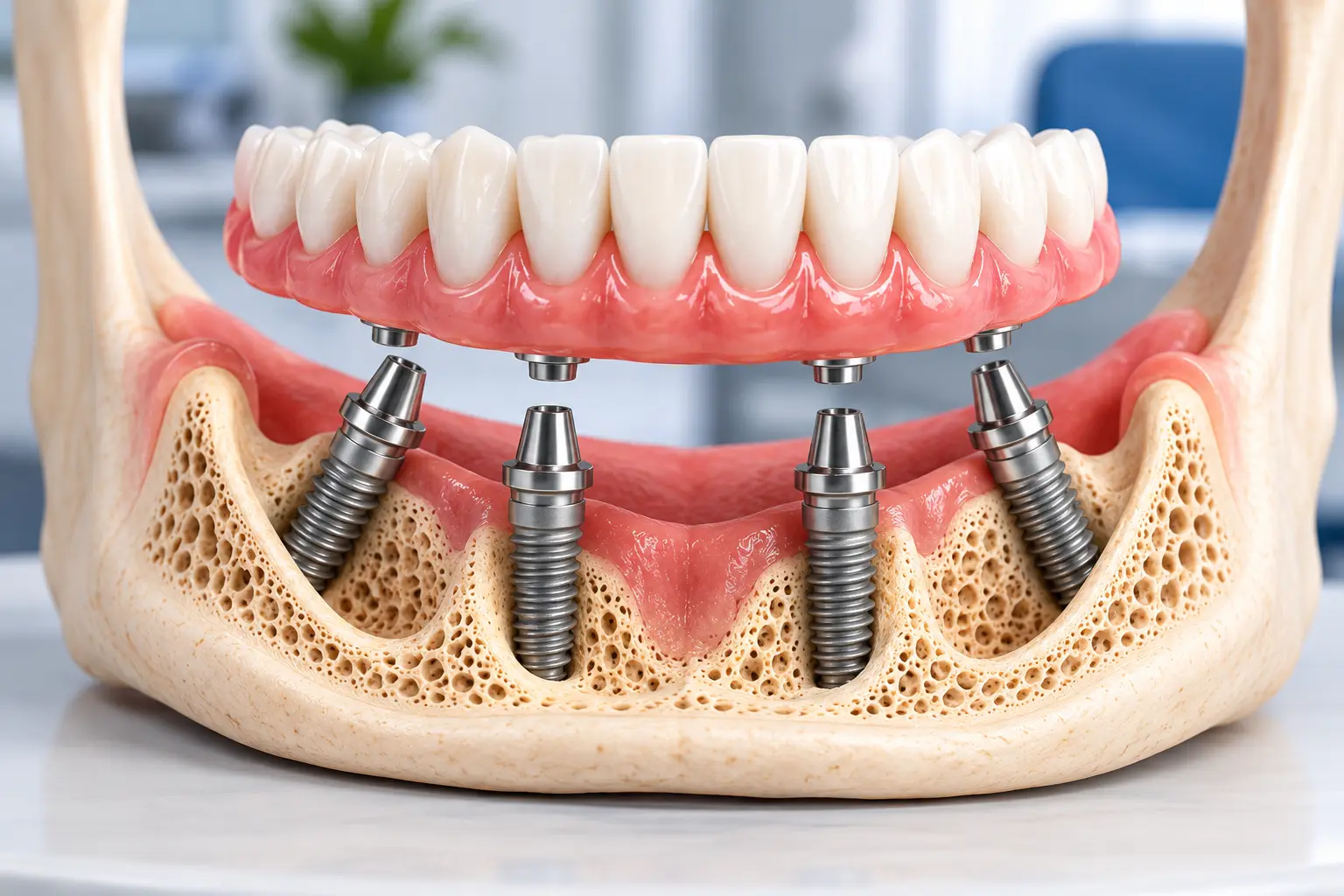
Often, yes. All-on-4 was designed with reduced bone in mind, which is one reason it is so often suggested for people who have lost teeth for some time or have worn dentures for years. But it is not suitable for everyone. If bone loss is severe, you may need a bone graft first, or a different type of treatment.
The only way to know for certain is a proper assessment and scan. Here is how bone loss affects All-on-4, what we look at, and what your options are.
What is All-on-4?
All-on-4 replaces a whole arch of teeth with a fixed set that is held on four dental implants. Instead of one implant per tooth, the set of teeth is supported by a small number of strategically placed implants, and two at the back are usually angled. Unlike a removable denture, it does not come out for cleaning in the same way and does not slip. We cover the basics in our post on all the facts on All-on-4.
Why does bone loss matter for dental implants?
An implant is anchored in the jawbone, so it needs enough healthy bone to hold it firmly while it bonds. After teeth are lost, the bone that held them gradually shrinks, because it is no longer being used. The longer a gap has been there, and the longer you have worn dentures, the more bone is typically lost.
Bone can also be lost through gum disease, injury or infection.
Can All-on-4 work if you have bone loss?
Frequently, yes. A big reason is the angled implants. By tilting the back implants, we can often anchor them in bone that is still available and avoid areas where bone is thin, such as near the sinuses in the upper jaw. That can mean fewer or no bone grafts for some people compared with placing an implant for every tooth.
It does not mean All-on-4 never needs grafting. It means we have more options for working with the bone you have.
What happens if bone loss is severe?
With severe bone loss, there may not be enough bone for All-on-4 as it is normally planned. Depending on the situation, we might recommend:
- building up the area with a bone graft before placing implants
- a sinus lift in the upper jaw, where the sinus sits close to the bone
- a different way of planning the implants
- an alternative to a full arch of fixed teeth, such as a denture held in place by implants
We will explain which makes sense and why, and we will be honest if we do not think All-on-4 is right for you.
Will you need a bone graft before All-on-4?
Not necessarily. Some people have enough bone for All-on-4 as it stands, and the technique can reduce the need for extensive bone grafting in selected patients. Others need a graft first to give the implants a solid base. We cannot tell which group you are in without a scan, so we assess before we recommend anything.
How is bone loss assessed?
At your consultation we look at your mouth, gums and remaining teeth, ask about your medical history and take scans, including a 3D scan where needed, to see the height, width and quality of the bone. That tells us where implants can go, whether grafting is needed, and what the treatment would involve.
It is a good idea to bring any previous X-rays or notes you have.
Can you have All-on-4 if you have gum disease and bone loss?
Gum disease is a common cause of bone loss, and it has to be treated and controlled before implants. Healthy gums are essential for implants to last. If you have active gum disease, we will treat that first and then reassess the bone. Our post explains whether gum disease can stop you getting dental implants.
Can All-on-4 replace dentures?
Yes, it is a popular choice for people who are tired of dentures that move or rub. A fixed set of teeth on implants feels more secure, and many people find it easier to eat and speak with. It is a surgical treatment, though, so it needs proper assessment and is not automatically right for every denture wearer. If you would like to look at your options, we can also talk about dental implants more generally.
How long does All-on-4 take?
The time depends on your case, including whether a graft is needed beforehand and how you heal. Our guide on how long All-on-4 takes from start to finish walks through the stages.
Who may not be suitable for All-on-4?
All-on-4 may not be the right choice if:
- there is not enough bone, even with grafting, for the plan to work
- gum disease is active and has not been treated
- you have health conditions or take medicines that affect healing, which we would discuss with you
- you smoke heavily and are not willing to cut down, as it can affect how implants heal
That does not always rule out treatment. Often it means we plan differently or prepare first.
Looking after All-on-4 and your bone
Implants need caring for like natural teeth. Brush twice a day, clean around the implants as we show you, and keep up regular checkups and hygiene appointments. Healthy gums help protect the bone that supports your implants.
Frequently asked questions
Can you get All-on-4 with bone loss?
Often, yes. The angled back implants make use of the bone that remains. If bone loss is severe, a graft or a different plan may be needed.
Can you get All-on-4 without a bone graft?
In many cases, yes, particularly when the angled implants can reach enough bone. Whether you need one depends on your scan.
Is there a limit to how much bone loss All-on-4 can handle?
There is a point where the bone is too thin or too little to support the implants safely without extra treatment. Where that point is depends on your jaw, which is why we assess each person individually.
Will you need a sinus lift for All-on-4?
Only some people do, usually in the upper jaw if the sinuses sit very close to the bone. A scan will show whether it is needed.
Can you have All-on-4 if you have worn dentures for years?
Many people with long term denture wear still have a good option, because the technique is planned around the bone that is left. We will check this at your assessment.
What are the alternatives if All-on-4 is not suitable?
We might suggest a bone graft followed by implants, a denture secured by implants, or a different implant plan. We will talk through each so you can decide.
Wondering if All-on-4 is right for you?
If you have lost bone and want to know where you stand, the best next step is an assessment. Get in touch to arrange a consultation at our Hatch End clinic, and we will tell you honestly whether All-on-4 is a good fit, and what we would do if it is not.