



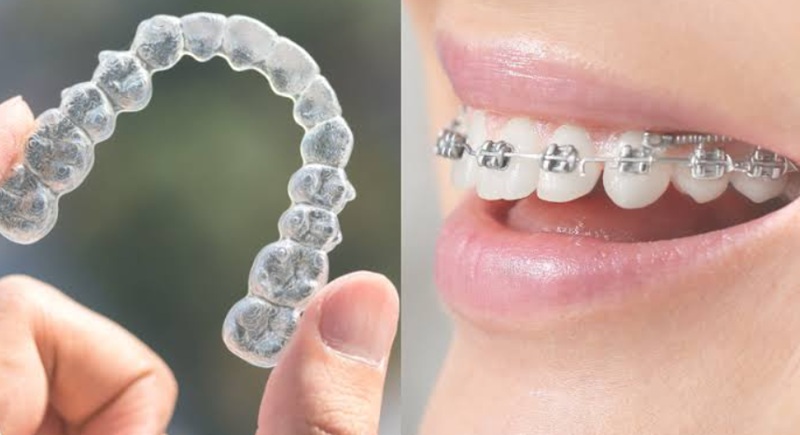
Both Invisalign and braces do the same job in the end: they move crooked or crowded teeth into a straighter position. The difference is how they get there. Invisalign uses a series of clear, removable aligners that most people never notice. Braces are fixed to your teeth and stay put for the whole treatment. This guide compares the two honestly on cost, comfort, appearance, treatment time and which cases each one handles best, so you can work out which suits you before you book a consultation.
The short version: for mild to moderate cases Invisalign is usually the more comfortable, discreet choice, and the price often overlaps with braces. For complex bite problems, fixed braces still do some things aligners cannot. At Aqua Dental in Hatch End, Invisalign starts from £3,695 and fixed braces from £3,500.
Invisalign vs braces at a glance
| Invisalign | Fixed braces | |
|---|---|---|
| Appearance | Clear, nearly invisible | Visible (metal), or tooth-coloured ceramic |
| Removable | Yes, for eating and cleaning | No, fixed for the whole treatment |
| Comfort | Smooth plastic, no wires | Brackets and wires can rub at first |
| Best for | Mild to moderate cases | All cases, including complex bites |
| Food | No restrictions (aligners come out) | Avoid hard and sticky foods |
| Cleaning | Brush and floss as normal | Harder to clean around brackets |
| Cost at Aqua | From £3,695 | From £3,500 |
Which is cheaper, Invisalign or braces?
People assume braces are always cheaper, and that is not quite true anymore. Metal braces can start lower, but the ranges overlap heavily once you match them by how much work your teeth need. A moderate case often lands around the same figure either way. Across the UK, Invisalign runs roughly £1,500 to £5,500 depending on the version, while fixed braces run from about £1,500 for basic metal up to several thousand for ceramic or lingual.
At Aqua, Invisalign starts from £3,695 and fixed braces from £3,500, and both can be spread with 0% finance. The honest way to compare is not the headline price but a quote for your specific case, which is what a consultation gives you. Our Invisalign cost page breaks the pricing down in full.
Comfort and appearance
This is where most adults lean towards Invisalign. The aligners are smooth and sit closely over your teeth, so there are no brackets or wires to rub the inside of your cheeks, and nothing shows in photos or conversation. You take them out to eat, so nothing is off the menu. Braces have come a long way, and ceramic brackets are far less obvious than the metal train-track image people remember, but they are still fixed and still visible up close.
The trade off with Invisalign is discipline. The aligners only work if you wear them 20 to 22 hours a day. Braces do their job whether you think about them or not, which for some people, especially younger teenagers, is genuinely an advantage.
Which cases suit each one?
Invisalign handles more than people expect: crowding, gaps, mild to moderate bite issues, and relapse after old braces. Where fixed braces still win is on the harder end, large rotations, teeth that need to move a long way, and complex bite corrections. A good orthodontist will tell you honestly if your case sits in that harder group, rather than forcing an aligner to do a brace’s job. You can see the kinds of problems clear aligners handle on our treatable cases page.
It is also worth knowing the middle-ground options. If you only want your front teeth tidied quickly, six month braces can be faster, and Spark clear aligners are an aligner alternative to Invisalign. Full fixed treatment is covered on our fixed braces page.
How long does each take?
Treatment times are broadly similar for comparable cases. Invisalign usually runs 6 to 18 months, with many cases finishing around a year and simple ones sooner. Fixed braces typically run 12 to 24 months, sometimes longer for complex work, because they are often used on the harder cases in the first place. Our guide on how long Invisalign takes goes into the detail.
Are either available on the NHS?
For adults, almost never. NHS orthodontics is funded only for under-18s with a clear clinical need, and even then it means fixed braces, not Invisalign. Adult treatment, whether aligners or braces, is a private choice, which is why comparing cost and finance properly matters.
So which should you choose?
If your case is mild to moderate and you value being discreet and comfortable, Invisalign is usually the better fit, and the price is often no higher than braces. If your case is complex, or you would rather have something that works without daily discipline, fixed braces may be the smarter call. The only way to know for certain is an assessment and an honest conversation, which is exactly what we offer. Start on our main Invisalign guide or come in and we will lay out both routes for your teeth.
Frequently asked questions
Is Invisalign as effective as braces?
For mild to moderate cases, yes, Invisalign achieves comparable results. For complex bite corrections or teeth that need to move a long way, fixed braces are sometimes more effective, which is decided at your consultation.
Is Invisalign cheaper than braces?
Not always, but the costs overlap more than people think. Basic metal braces can start lower, while Invisalign and ceramic or lingual braces sit in a similar range. At Aqua, Invisalign is from £3,695 and fixed braces from £3,500.
Do braces work faster than Invisalign?
Not usually. Timelines are similar for comparable cases. Braces can appear to take longer mainly because they are often used on more complex cases in the first place.
Can I switch from braces to Invisalign?
In many cases yes, especially if your treatment is mild or you are correcting a relapse. Your dentist will confirm whether your case is suitable to continue with aligners.
Compare your options with us
The best way to choose between Invisalign and braces is to see what your own teeth need. Book a consultation and we will assess your case, show you a preview of the result, and give you a clear price for both routes with finance options. We see patients from Hatch End, Pinner, Harrow and across North West London. Book a consultation, or if you are new to us, start on our new patients page.
Reviewed by the clinical team at Aqua Dental Clinic, Hatch End. Prices correct as of 2026 and confirmed after examination. This article is general information, not a substitute for a dental assessment.