
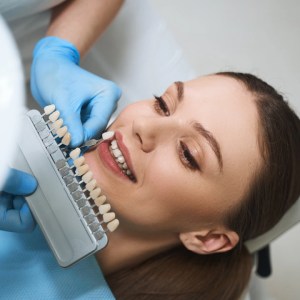
Traditional porcelain veneers usually call for 0.5mm to 0.7mm of enamel to be filed away so the veneer sits flush against the tooth. Ultrathin veneers turn that process on its head. Advances in ceramic manufacturing mean a shell can now be milled thin enough, close to the thickness of a contact lens, to bond directly over most of the tooth’s original surface.
The result looks and feels closer to natural enamel, partly because there is more natural enamel left underneath it. Patients who have been told in the past that veneers mean “filing your teeth down” are often surprised to learn how much has changed.
Dr Neera Maini and Dr Nikita Maini built Aqua Dental Clinic’s reputation on gentle, unhurried care, and the practice is Dental Phobia Certified for exactly this reason. Ultrathin veneers fit that approach well. With minimal or no enamel removed, most patients don’t need a local anaesthetic injection at all, which removes one of the biggest sources of dental anxiety before treatment has even started.
That does not mean the process is rushed. A cosmetic dentist confident with thin veneer systems still needs a steady hand and an eye for detail, since there is very little margin for error when a shell is this thin. It simply means the experience of getting there is calmer.
Patients researching veneers online are often choosing between three treatments that get grouped together but behave quite differently in practice. Here is how they compare.
| Factor | Ultrathin Veneers | Traditional Porcelain Veneers | Composite Bonding |
|---|---|---|---|
| Tooth preparation | Little to none, often 0.3mm or less | 0.5mm to 0.7mm of enamel typically removed | None, resin is added directly to the tooth |
| Material | Thin ceramic shell | Thicker ceramic shell | Composite resin |
| Typical lifespan | 10 to 15 years or more with good care | 10 to 15 years or more with good care | 5 to 8 years, often needs earlier touch ups |
| Reversibility | Often reversible or replaceable with minimal impact | Not reversible once enamel is removed | Reversible, resin can be removed |
| Best suited for | Healthy teeth needing a colour or shape change, nervous patients | More significant shape, gap or alignment correction | Small chips, gaps or one off touch ups |
As a general rule, ultrathin veneers suit patients with healthy teeth who mainly want to change colour, close small gaps or refine shape. More significant misalignment or very heavily discoloured teeth may still respond better to traditional veneers or orthodontic treatment first, which is exactly the kind of judgement call worth making at a consultation rather than online.
Ultrathin veneers work well for many patients, but not everyone. A short assessment at consultation will confirm suitability, though the following gives a useful starting point.
This is a fairly common area of disagreement between clinics, since some will fit thin veneers onto almost any case. At Aqua Dental, the preference is a bespoke, case by case recommendation, even if that occasionally means suggesting a different treatment altogether.
Most patients complete the process across two to three appointments, spread over two to four weeks depending on lab turnaround and how many teeth are involved.
With good oral hygiene and regular dental check ups, ultrathin veneers typically last 10 to 15 years, and it is common for well maintained cases to last longer. Lifespan depends heavily on the individual: teeth grinding, biting nails or opening packaging with your teeth all shorten how long any veneer lasts, thin or otherwise.
A well fitted set of ultrathin veneers, checked at routine hygiene visits, is a genuinely long term investment rather than a short lived cosmetic fix.
It’s a fair question. Something this thin sounds like it should be fragile. In practice, the ceramics used for modern ultrathin veneers are engineered specifically for strength at a fraction of the thickness of older veneer materials, using layered, translucent porcelain that also happens to reflect light in a way that mimics natural enamel closely.
Bonded correctly to healthy enamel, ultrathin veneers cope well with normal biting and chewing. The exceptions are the same ones that threaten any veneer: chewing ice, biting pens, or grinding at night without a guard.
Across London clinics, ultrathin and no prep veneers are generally priced from around £900 to £1,400 per tooth, with most quotes depending on the number of teeth treated and the complexity of the smile design. Aqua Dental Clinic offers 0% finance, which spreads the cost of treatment into manageable monthly payments rather than one lump sum. This is worth raising at your consultation alongside your quote.
Sometimes a very small amount of enamel is smoothed to help the veneer bond and sit correctly, but in many cases little to none is removed. This is confirmed for your specific teeth at consultation.
Most patients don’t need an anaesthetic injection because so little of the tooth is affected. Any mild sensitivity afterwards is usually short lived.
Because minimal or no enamel is removed, ultrathin veneers are often reversible or replaceable, unlike traditional veneers, which permanently alter the tooth underneath once fitted.
Yes, when properly designed. The thin, layered ceramic used reflects light similarly to natural enamel, and your dentist will match shade, shape and translucency to the rest of your smile.
Most patients need two to three appointments across two to four weeks, covering consultation, design, and fitting.
If drilling, injections or a long treatment timeline have put you off veneers in the past, ultrathin veneers are worth a conversation. Book a consultation with Aqua Dental Clinic in Harrow to find out whether they’re the right fit for your smile, and ask about 0% finance while you’re there.